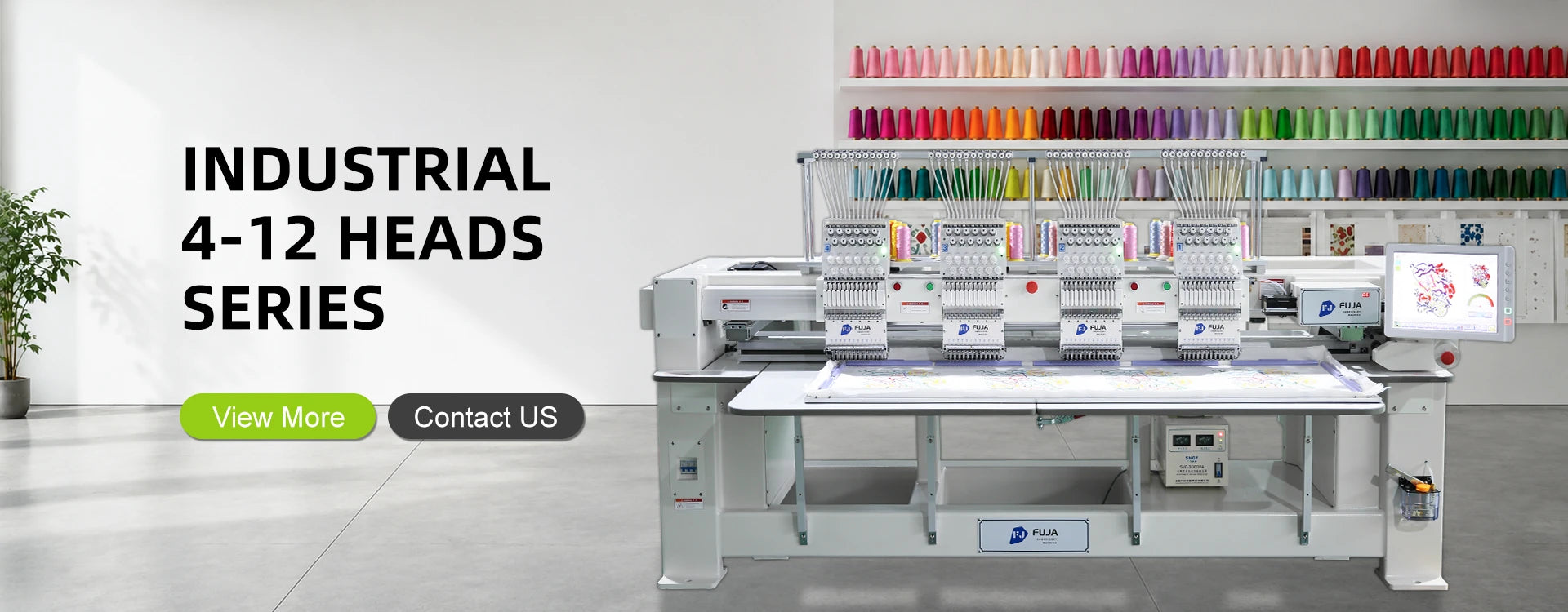
Industrial · Multi-Head
Industrial Multi Head Embroidery Machines
Compare four- to 12 head configurations for sustained batch production. Verify frame structure, needle count, field size, drive system and factory requirements by model.
Compare four- to 12 head configurations for sustained batch production. Verify frame structure, needle count, field size, drive system and factory requirements by model.
An industrial multi-head embroidery machine is built for factories that live and die by throughput and cost-per-piece.
Select the number of heads from sustained order volume, batch size, product mix, floor space, electrical requirements, operator capacity and service plan. Do not size a production line from maximum speed or head count alone.
Review approved technical specifications, site requirements, installation scope, training and spare parts planning before purchase.
The heavy-duty four-head. Reinforced HQ build and a 15-inch horizontal screen — for factories that run it all day, every day.
Six heads, factory rhythm. HQ-grade frame and controls for uniform quality across every head.
Eight heads for serious volume: one operator, eight identical garments per run.
Our maximum-throughput machine: twelve heads for mass production lines where output per operator decides the margin.
More heads can lower labor and setup cost per piece on repeat batches, provided order volume and operator workflow keep the line utilized.
Frame and drive designs vary by model. Evaluate vibration, alignment, service access and sustained production requirements with the technical team.
Choose the needle count per head according to the color complexity and changeover frequency of your regular designs.
Request current factory documentation, model test records and the exact inspection plan for the machine being quoted.
Choose four to twelve heads according to validated production demand and available floor space.
Confirm the frame, drive and control configuration for sustained operation on the selected model.
Use the control interface for file management, color sequencing and production monitoring.
Transfer compatible files by USB and use network transfer where supported.
Automatic trimming and color change functions reduce manual handling across active heads.
Installation, operator training and remote technical guidance should be defined in the project scope.
Industrial lines are not always the best first step. Compare commercial multi head and single head options while order volume or product mix is still developing.
Industrial models typically use more heads and production oriented frame and drive configurations. Commercial two- to 4 head systems may suit smaller repeat batches and more flexible shop environments.
Multiple heads stitch identical pieces during one cycle, spreading operator and setup time across a larger batch. Savings depend on utilization, labor, design length, reject rate and maintenance.
Base the decision on sustained monthly volume and common batch size. FUJA should review your production data before recommending four, six, eight or twelve heads.
Rigid frames help control alignment and vibration across multiple heads. Ask for structural and installation details for the selected model.
Application capability is specific to each configuration. Share your apparel, caps, frames and design sizes so the technical team can confirm compatibility.
Warranty, installation, training, spare parts and response terms should be documented for the specific industrial project rather than assumed from a general website statement.
Tell us what you plan to embroider, your expected volume, destination and preferred configuration. FUJA will review the request and respond according to the inquiry, time zone and team availability.
For machine purchases, distributor programs and OEM/ODM projects.